
How Hard Water Affects Plumbing Pipes, Faucets and Water Heaters
Learn how hard water affects plumbing pipes, faucets and water heaters, including mineral scale, low water pressure, maintenance needs and plumbing solutions.
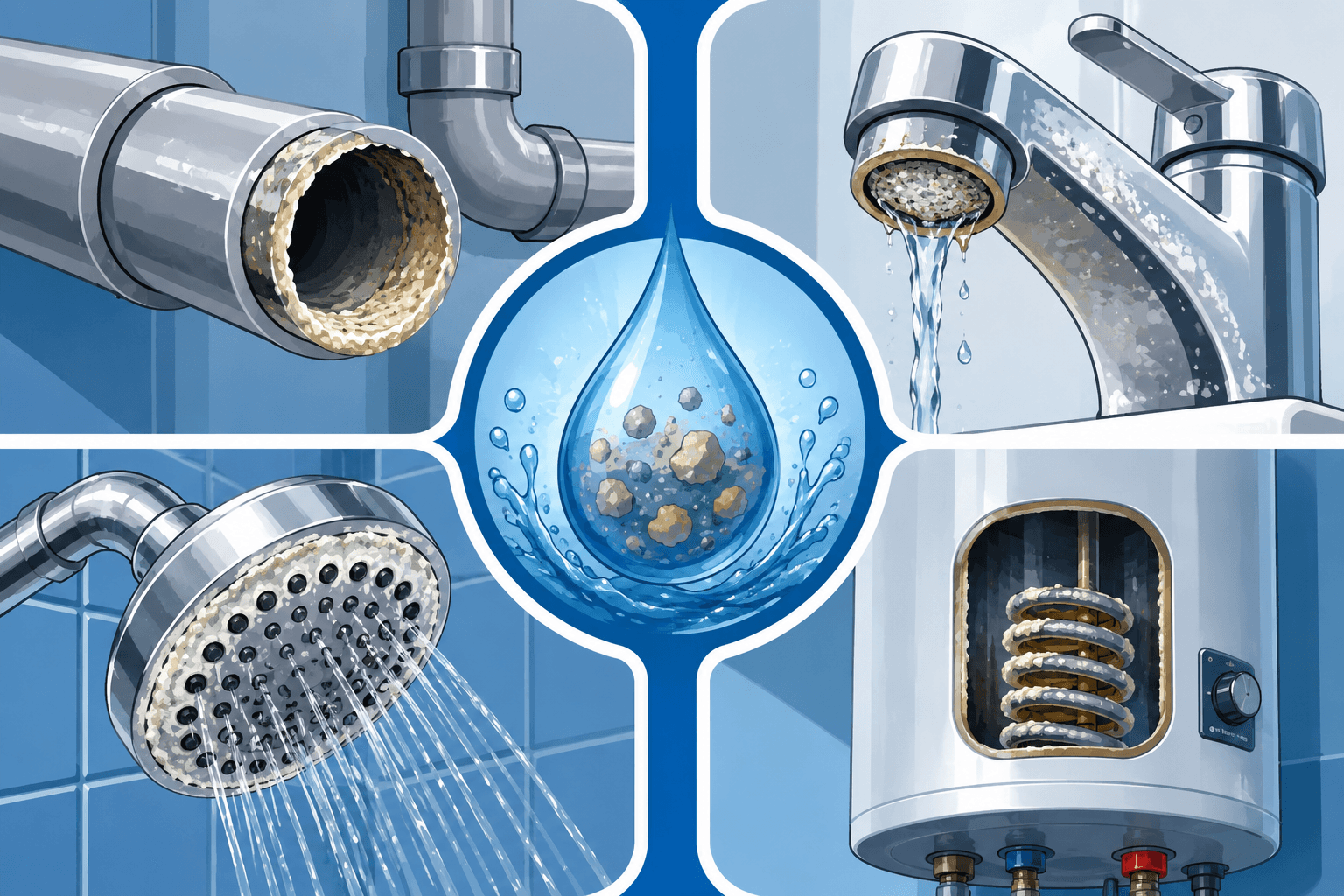
How Hard Water Affects Plumbing Pipes, Faucets and Water Heaters
Hard water is very common in many areas of our country—and may pose some challenges to your home or business’s plumbing systems. While water hardness is typically more of a nuisance than an actual health issue, over time dissolved minerals (like calcium & magnesium) will build up as scale inside your plumbing fixtures, pipes, and water heating equipment.
Knowing how hard water impacts your plumbing system helps you identify these early warning signs and take steps to prevent unwanted plumbing issues. Let’s go through what hard water actually is and how it can impact your plumbing!
What Is Hard Water?
The term “hard” refers to the concentration of dissolved calcium and magnesium in the water. The USGS defines water with hardness from 0-60mg/L (as CaCO3) as soft; between 61-120mg/L as moderately hard; 121-180mg/L as hard and above 180mg/L as very hard.
Water usually becomes harder naturally when it flows over and absorbs minerals (such as limestone, dolomite and gypsum) in the rocks and soils that form its path. In these cases, calcium and magnesium dissolve into the water.
The first thing that homeowners tend to notice about hard water are the white/chalky deposits you’ll see around your taps (and around your fixtures), the scale you will find around showerheads, reduced water flow, and deposits found around your water heating equipment.
Mineral deposits inside your plumbing system might be more serious than that.
How Hard Water Affects Plumbing Pipes
One of the biggest problems with hard water as it relates to your plumbing system involves scale formation. As you know, our drinking water has several minerals dissolved within its contents.
As these types of waters move through pipes, their calcium and magnesium-based compounds begin to precipitate along the inner surface of pipes over time causing an increase in pipe diameter size. According to the USGS, “long term movement of hard water through pipes can lead to scale build up which will decrease the internal diameter and reduce water pressure.”
Possible Effects on Pipes
Hard-water scale can contribute to:
Low water flow / Low water pressure Restricted Pipe Capacity High Maintenance Requirements Scale Accumulation around plumbing components
Note – Hard water is not the sole reason for low water pressure or issues with your pipes. A Professional Inspection can be helpful if you're unsure what's causing these problems
Why Hard Water Leaves Deposits on Faucets
Faucet fixtures are especially prone to hard-water deposits since they’re constantly coming in contact with water. Hard Water Deposits Happen When Dissolved Minerals Remain After Evaporation
Over time, these deposits may become visible around:
Faucet outlets Tap aerators Showerheads Valve components Sink fixtures Connections
Sometimes mineral buildup will restrict the flow through smaller openings (aerators for example) causing the water stream to be affected.
While regular cleaning can eliminate these surface level deposits, if you experience consistent or significant amounts of this buildup then there’s likely an issue with your underlying water chemistry that’s contributing.
The Effect of Hard Water on Water Heaters
Water heaters are particularly susceptible to scale buildup due to their use of hard water being heated.
Heating hard water may result in solid calcium carbonate deposits according to the U.S. Geological Survey (USGS). These deposits may decrease equipment life, raise water-heating costs, impact efficiency for electric water heaters, and lead to pipe-clogging issues. Why does this happen?
The reason is straightforward:
Mineral scale doesn’t transfer heat quite as well as the metal surfaces designed to heat your water. Similarly, the US Environmental Protection Agency explains that scale forms inside of your water heater and does not conduct heat well, possibly decreasing the efficiency of your heater’s operation over time.
This could mean that you’d need to give some extra love to your water heater if scale begins to build up on its surfaces.
Signs That Hard Water May Be Affecting Your Plumbing
If you’re trying to decide whether your tap water contains hard minerals, here are some telltale indicators to be aware of:
White/Chalky deposits on taps (⚪) Reduced water flow out of fixtures (🚿) Repeatedly clogged faucet aerators (🔧) Scale around showerheads (🚿) Deposits inside plumbing fixtures (💧) Changes in water pressure (📉) Reduced performance by your water heater (🔥) Frequent need to clean off mineral deposits (🧽) Scale around hot-water equipment (⚙️)
But these symptoms don’t necessarily indicate your home has hard water as an underlying cause — they could result from other causes too.
There are many possible causes for plumbing problems so if you are having persistent issues with your pipes, it’s best to get them properly assessed.
Hard Water and Plumbing Maintenance
However, there are certain situations where preventive plumbing maintenance will come in handy.
For example, if your property experiences some kind of persistent hard water issues.
A professional plumbing inspection can help identify:
Check for scale buildup. Look out for restricted flow. Watch for leaking connections. Identify damaged fixtures. Fix other plumbing issues.
Your maintenance should also involve checking on the state of your various plumbing systems before a small issue grows into a major one.
What Should Be Checked? Pipes
Inspection of accessible plumbing lines to check for leaks, restrictions, corrosion, or other signs of deterioration.
Faucets and Fixtures
Check aerators, taps, valves & connections for mineral buildup/malfunction.
Water Heaters
To inspect the system for signs of scale, leakage and other maintenance requirements as recommended by the manufacturer.
Water Pressure
Check if the unusual pressure changes may be caused by your plumbing or some other issue.
Can a Water Softener Help?
Water softeners remove calcium and magnesium that cause hard water.
NSF explains that “residential cation-exchange (water) softeners remove hardness from water by exchanging calcium and magnesium ions for sodium or potassium ions”.
But you don’t necessarily need to get one if your home doesn’t have hard water – the EPA recommends considering them depending on the level of hardness, along with appliance requirements, local regulations and/or guidance from your water utility.
The Important Point
Select Water Treatment based on your actual water conditions – Not all plumbing systems need the same kind of water treatment.
Hard Water Does Not Mean Your Plumbing System Is Failing
It's also important to differentiate between having hard water vs. a plumbing problem. A leaking pipe, for example, or low water pressure, could be due to other problems besides scale build up — such as a blocked drain or faulty faucet.
For example, low pressure can result from:
Restricted pipes
Faulty valves
Supply issues
Plumbing blockages
Other plumbing conditions
You need to see an expert such as a professional plumber who will be able to locate your issue.
How Professional Plumbing Maintenance Can Help
There are many issues that property owners face with their homes related to hard water as well as general wear and tear on pipes. Some of these include: Plumbing inspections Pipe Repair Water Leak Repairs Faucet & Tap Repairs Drain Cleaning Bathroom Plumbing Water-Heater Related Plumbing Assistance Plumbing Maintenance Fixture Inspection Emergency Plumbing Services
When applied to residential property, preventive maintenance on your plumbing system can ensure that all aspects of the home’s bathroom, kitchen, and other water-supply lines and fixtures continue to run smoothly.
Preventive maintenance becomes even more crucial when working with commercial property as its plumbing systems often support multiple people throughout the course of the day.
So, when should you call a professional plumber?
Consider professional plumbing assistance if you notice:
Persistent low water pressure
Repeated faucet blockages
Significant mineral buildup
Water leaks
Reduced hot-water performance
Repeated plumbing fixture problems
Pipe restrictions
Unusual changes in water flow
Problems affecting multiple fixtures
If you’re unsure of what’s causing your water problem, a professional should be able to figure out if there are issues with hard-water scale, plumbing defects, water pressure, aging components or other causes.
Plumbing Services for Homes and Businesses
At Gigwell Services, we provide you with professional plumbing and home maintenance solutions for your residential and commercial properties.
Its plumbing services can assist with:
Water leak repair. Pipe repair. Drain cleaning. Bathroom plumbing. Faucet & tap repair. Toilet services. Plumbing maintenance.
Are you having any recurring problem related to plumbing? Want someone professional to take care of your property’s plumbing systems?
Explore our plumbing services here at Gigwell Services. We also provide Electrical, Handymen & Carpenters Services for your comfort!
Conclusion
It doesn’t always indicate that there’s something wrong with your plumbing system, but over time, having constant contact with mineral-rich hard water can lead to scale build-up in plumbing pipes, faucets, fixtures and even water heaters.
Knowing what these tell-tale signs look like will help you know if you need to schedule cleanings/maintenance or consider some kind of water treatment process—or call in a licensed plumber for an inspection.
Regular plumbing maintenance is an essential part of protecting your home or business against problems with its long-term operation.
When you see issues such as mineral buildup or low water pressure, leaks or recurring plumbing problems, the key to finding the best solution starts by understanding what’s really going on under the surface.
Need a plumber or bathroom upgrade in Morbi?
Contact Gigwell